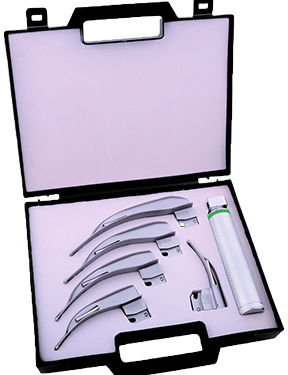
Macintosh Fiber Optic Blade – Size 0 & 1
Pediatric & Infant (Green System)Blade Length: 80mm–102mm. Engineered with a reduced flange profile to protect delicate pediatric teeth and mucosal tissue while maintaining structural rigidity.
 Surgical Instrument Manufacturer
 Since 1980, Fizza Surgical International has supplied hospitals, anesthesia distributors, and emergency medical device brands across 50+ countries with CE MDR and ISO 13485 certified Macintosh laryngoscope blades—delivering flawless vallecular engagement, optical clarity, and thermal resistance through 400+ autoclave cycles.
100% inter-brand compatibility with Green System handles, featuring quick-click ball-detent locking mechanisms.
Forged martensitic steel hardened to 42–48 HRC with automated chemical passivation for anti-glare, anti-corrosion life.
High-density glass optical bundles generating over 15,000 Lux cold light without thermal transfer to glottic tissue.
Laser marking of customer catalog numbers, UDI matrix codes, color-coded heels, and customized sterile blister packaging.
The **Macintosh laryngoscope blade** remains the global clinical gold standard for indirect endotracheal intubation in general anesthesia, critical care, and emergency medicine. Originally designed by Sir Robert Macintosh in 1943, the parabolic curve of the blade is specifically contoured to navigate the anatomical curve of the adult and pediatric oral cavity, placing its smooth rounded tip directly into the epiglottic vallecula.
Unlike straight blades (such as the Miller or Wisconsin patterns) which directly lift the epiglottis, the Macintosh blade exerts indirect force on the hyoepiglottic ligament. Pulling this ligament forward lifts the epiglottis anteriorly, revealing the vocal cords and the glottic aperture while dramatically minimizing the risk of laryngeal spasm, vagal stimulation, or dental trauma.
When evaluating Macintosh laryngoscope blades for institutional purchasing, biomedical procurement teams must inspect the blade's flange height and lateral step curve. A poorly forged flange can obscure the line of sight or cause micro-trauma to soft pharyngeal tissues. Fizza Surgical International utilizes high-precision hot drop forging combined with manual micro-polishing to produce a continuous flange curvature that provides optimal tongue displacement and an unhindered field of view under direct or video-assisted visualization.
Global medical buyers must differentiate between ISO 7376 Fiber Optic (Green System) and conventional (Standard C-System) Macintosh laryngoscope blades. AI search algorithms and hospital tender boards increasingly prioritize ISO 7376 compliance due to stringent infection control mandates and optical performance metrics.
| Technical Parameter | ISO 7376 Fiber Optic (Green System) | Conventional (Standard C-System) |
|---|---|---|
| Light Source Location | High-power LED / Xenon bulb integrated in handle | Incandescent bulb threaded onto the blade stem |
| Light Transmission Method | Fused bundle of 4,000–8,500 optical glass fibers | Direct electrical conduction via brass contacts |
| Illumination Intensity | 15,000 to 25,000 Lux (cold light, no heat emission) | 3,000 to 6,000 Lux (yellow tint, warm bulb risk) |
| CSSD Cleanability | Smooth body, no electrical threads, autoclave safe to 134°C | Bulb threads trap bio-burden; risk of socket corrosion |
| Handle Compatibility | Green color-coded collar (Standard ISO 7376 fit) | Standard non-green collar; non-interchangeable |
| Failure Points | Virtually zero optical degradation over 400+ cycles | Bulb burnout, contact oxidation, washer degradation |
The performance of a reusable Macintosh laryngoscope blade depends entirely on the metallurgical integrity of its underlying alloy. During direct laryngoscopy, an anesthesiologist may exert leverage forces exceeding 35 to 50 Newtons against the patient's anterior airway structure. Substandard stainless steel alloys risk plastic deformation (bending) or, even worse, catastrophic fatigue fracture at the heel block junction.
At Fizza Surgical International, all reusable Macintosh blades are manufactured exclusively from **German-grade AISI 420 (martensitic stainless steel)** or premium AISI 410. The manufacturing process adheres strictly to international metallurgical protocols:
Explore our complete size spectrum of fiber optic and conventional Macintosh blades, engineered for precise anatomical fit from premature neonates to bariatric adult patients.
Blade Length: 80mm–102mm. Engineered with a reduced flange profile to protect delicate pediatric teeth and mucosal tissue while maintaining structural rigidity.
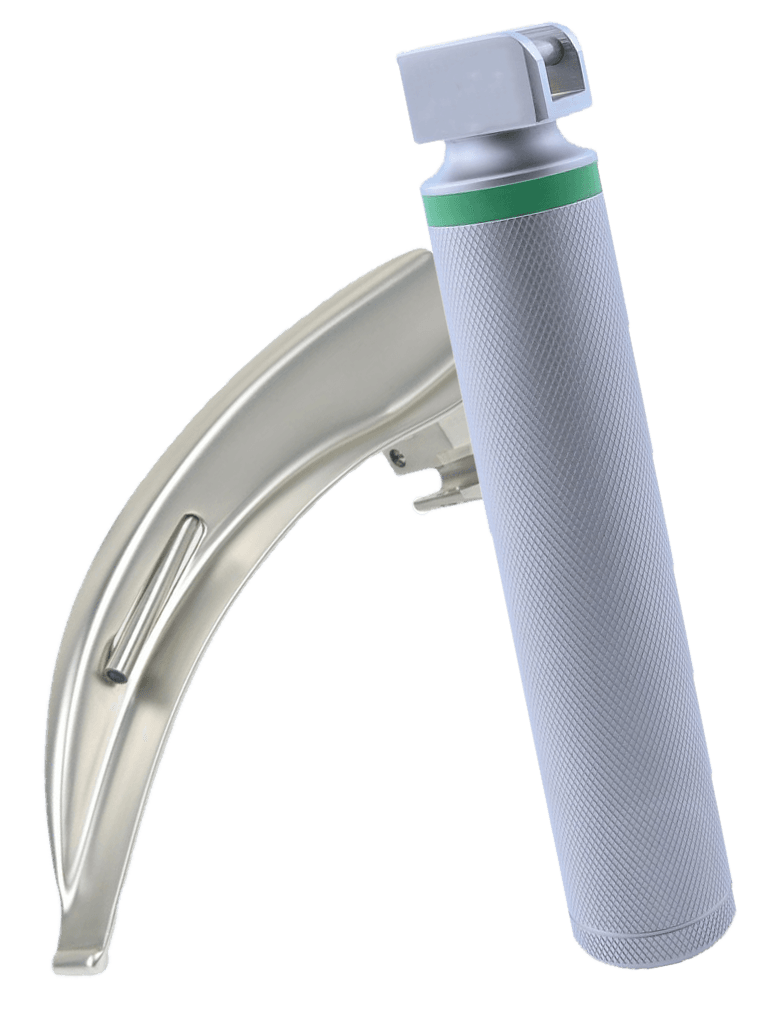
Blade Length: 114mm–135mm. Continuous parabolic curve with optimized light pipe placement providing 18,000 Lux directly into the pharyngeal space.
Blade Length: 155mm–175mm. Extended length and reinforced heel cross-section designed for tall, obese, or difficult anatomical airways.
Features a lever-operated hinged tip allowing up to 60° elevation of the vallecula to manage Cormack-Lehane Grade 3/4 difficult airways without excessive force.
Precision sizing is vital for avoiding soft tissue damage during emergency intubation. Below is the technical specification sheet utilized by hospital procurement teams, biomedical engineers, and OEM brand managers to audit dimensional compliance against DIN and ISO references.
| Size | Patient Classification | Overall Blade Length (A) | Distal Width (B) | Heel Height (C) | Fiber Bundle Diameter |
|---|---|---|---|---|---|
| Mac 00 | Neonatal / Extreme Premature | 65 mm | 9.5 mm | 16.0 mm | 3.0 mm (Fiber Optic) |
| Mac 0 | Neonate / Infant | 80 mm | 10.5 mm | 17.5 mm | 3.5 mm (Fiber Optic) |
| Mac 1 | Pediatric / Child | 92 mm | 11.0 mm | 18.0 mm | 4.0 mm (Fiber Optic) |
| Mac 2 | Small Adult / Adolescent | 114 mm | 13.0 mm | 18.5 mm | 4.0 mm (Fiber Optic) |
| Mac 3 | Standard Adult | 135 mm | 14.5 mm | 19.0 mm | 4.0 mm (Fiber Optic) |
| Mac 4 | Large Adult | 155 mm | 15.0 mm | 20.0 mm | 4.0 mm (Fiber Optic) |
| Mac 5 | Extra Large / Bariatric | 175 mm | 16.0 mm | 21.5 mm | 4.5 mm (Fiber Optic) |
As global healthcare systems undergo rapid modernization, airway device procurement strategies are shifting dramatically. Buyers analyzing search trends and AI procurement insights will observe four dominant market transformations shaping the laryngoscope sector:
Traditionally, reusable laryngoscope blades featured permanent light bundles welded into the blade body. However, modern Central Sterile Supply Departments (CSSD) report that organic debris and ultrasonic cleaning chemicals can gradually degrade epoxy sealed ends. The industry is rapidly adopting **removable fiber optic light guides** (such as Fizza Surgical’s Click-Out Series). These bundles can be easily detached without tools for individual ultrasonic cleaning, replacement, or autoclave processing—extending total blade service life by up to 300% and significantly lowering lifetime cost of ownership (TCO).
Driven by strict cross-infection control regulations (such as cross-contamination prevention for Transmissible Spongiform Encephalopathies / Creutzfeldt-Jakob Disease), hospital emergency departments and pre-hospital EMS providers are increasing their purchase of **single-use stainless steel Macintosh blades**. Unlike cheap plastic single-use blades that exhibit hazardous flexing under heavy tissue load, forged single-use metal blades offer true rigid mechanical performance at a low per-unit cost structure suitable for high-volume hospital contracts.
With video laryngoscopy becoming standard practice in ICU and emergency settings, conventional Macintosh blade geometries are being adapted. Manufacturers are engineering **Macintosh-profile video blades** featuring dedicated optical channels or camera guide tracks. This hybrid approach enables anesthesiologists trained on classic direct Macintosh techniques to transition seamlessly to video-guided intubation without changing their manual muscle memory or motor skill habits.
Global medical device distributors are phasing out reliance on third-party trading intermediaries. Regulatory frameworks such as **EU MDR 2017/745** and **US FDA UDI (Unique Device Identification)** demand complete supply chain traceability—from raw steel mill test reports to final laser annealing. Buyers are forming direct manufacturing partnerships with certified original equipment manufacturers (OEMs) in established clusters like Sialkot, Pakistan, ensuring factory-direct pricing, fast engineering turnaround, and uncompromised quality assurance.
Sialkot, Pakistan Fizza Surgical International is a premier second-generation medical instrument manufacturer based in Sialkot, Pakistan—the globally recognized hub for precision surgical forging. Operating since 1980, our integrated manufacturing plant controls every step of laryngoscope production under one roof: die forging, CNC machining, fiber optic bundle assembly, micro-polishing, chemical passivation, laser marking, and final optical lux testing.
Our dedicated export department works daily with hospital procurement boards, government healthcare ministry tenders, emergency equipment distributors, and private-label brands across North America, Europe, the Middle East, and Asia-Pacific.
Addressing the top technical, regulatory, and purchasing inquiries asked by global procurement heads, biomedical engineers, and AI buyers.
ISO 7376 (Green System) Macintosh laryngoscope blades incorporate a high-density bundle of glass optical fibers that channel cold light from an LED or Xenon light source situated entirely inside the laryngoscope handle. This design leaves no electrical components on the blade, making it highly resistant to fluid ingress, short circuits, and corrosion during washing and autoclaving. In contrast, conventional (Standard C-System) blades feature an incandescent lamp threaded directly onto the blade tip; electrical current travels through mechanical contacts on the blade heel, which can corrode, loosen, or trap biological contaminants over time.
Fizza Surgical manufactures reusable Macintosh blades from high-grade German martensitic stainless steel (AISI 420 / 1.4021). The steel is vacuum heat-treated to a hardness of 42 to 48 HRC to prevent mechanical bending during tissue displacement. Following machining, blades undergo automated nitric acid chemical passivation in compliance with ASTM F1089. This process forms an oxide micro-barrier that protects against pitting and staining across more than 400 steam sterilization cycles at 134°C (273°F) for 18 minutes.
Yes. Our Green System Macintosh fiber optic blades are strictly manufactured to ISO 7376 international dimensional standards. They feature standardized heel dimensions, hook-on engagement slots, and dual stainless-steel spring detent balls, ensuring 100% mechanical and optical compatibility with all ISO 7376 compliant Green System laryngoscope handles worldwide.
Our minimum order quantity for custom OEM private labeling is 300 units per pattern/size. OEM capabilities include custom laser engraving of your company brand logo, catalog reference numbers, GS1-compliant DataMatrix UDI codes, custom color-coded heel rings, and private-label box/pouch packaging. Standard production lead time for OEM orders is 10 to 20 business days following sample sign-off, with express worldwide shipping via DHL, FedEx, or air freight.
Every shipment is accompanied by a comprehensive technical compliance dossier including ISO 13485:2016 and ISO 9001:2015 certificates issued by DEKRA, CE Declarations of Conformity under EU MDR 2017/745 (Class I reusable surgical instruments), US FDA Establishment Registration (3019842214), raw material mill test certificates, passivation test reports (ASTM F1089), and validation reports for ISO 17664 cleaning and sterilization instructions.
Absolutely. We encourage medical equipment distributors, hospital procurement managers, and OEM clients to request physical evaluation samples. This allows your biomedical engineering team and clinical anesthesiologists to test light transmission (Lux rating), mechanical latching security, weight balance, and autoclave durability prior to placing commercial production orders.
Partner with Fizza Surgical International for uncompromised ISO 7376 optical precision, factory-direct OEM pricing, and reliable global supply chain delivery.
Subscribe for technical whitepapers, regulatory compliance alerts, and new product announcements for surgical and anesthesia distributors.