B2B Procurement & Engineering Specification Guide

The Definitive B2B Procurement & Technical Guide for Bone Cutting Forceps: Metallurgy, Intent-Driven Selection, and Global OEM Manufacturing

Evaluating structural shear mechanics, double-action compound leverage, AISI 420/440 metallurgical standards, and regulatory compliance under EU MDR 2017/745 for international orthopedic hospital buyers and surgical distributors.

Get Catalog Request OEM Quotation

Semantic Search & Procurement Intent in Modern Orthopedic Tooling

In the contemporary digital procurement landscape, global healthcare purchasing managers, tender committees, and surgical device OEM buyers rely heavily on AI search agents and semantic query engines to source hospital-grade surgical tools. Search intent has evolved beyond simple keyphrase matching into deep technical intent mining: buyers ask generative models precise queries regarding mechanical advantage ratios, edge preservation, autoclave stress corrosion, and raw material traceability.

Bone cutting forceps represent one of the most mechanically demanding instruments in orthopedic, spinal, podiatric, and maxillofacial surgical trays. Designed to sheer dense cortical bone, perform amputations, smooth bone spicules, and reshape skeletal structures, these instruments operate under intense localized stress. Selecting an unverified or sub-standard instrument manufacturer often results in jaw misalignment, stress cracking at the hinge joint, rapid blade dulling, or catastrophic instrument failure during trauma procedures.

At Fizza Surgical International, forged in Sialkot since 1980, we combine over four decades of traditional drop-forging craftsmanship with modern CNC machining, computer-controlled vacuum heat treatment, and stringent ISO 13485:2016 quality management systems. This engineering dossier provides absolute transparency and actionable information gain for procurement officers navigating the global medical device supply chain.

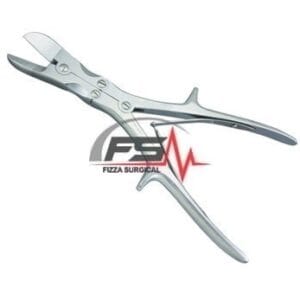
Orthopedic Bone Cutting Forceps manufactured by Fizza Surgical International

Engineering Snapshot

  • Steel Alloys: German AISI 420 / AISI 440 Martensitic
  • Hardness Range: 42–48 HRC (Vacuum Hardened)
  • Joint Architecture: Single-Pivot & Double-Action Compound Joints
  • Passivation Standard: ASTM F1089 Chemical Passivation
  • Compliance: CE Mark (EU MDR Class I), FDA Reg # 3019842214
Get Catalog
Product Taxonomy

Core Classifications of Bone Cutting Forceps

Understanding the anatomical intent and leverage dynamics across international standardized patterns.

Liston Bone Cutting Forceps

Liston Bone Cutting Forceps

Single ActionStraight/Curved14cm to 27cm

The classical Liston pattern features heavy-duty single-action blades engineered for osteotomies of long bones and amputations. Available in straight, angled on flat, and curved profiles to grant optimal line-of-sight during open orthopedic procedures.

Get Catalog →
Ruskin Double Action Bone Forceps

Ruskin Bone Cutting Forceps

Double ActionCompound Leverage18cm to 24cm

Incorporating a compound double-pivot joint mechanism, the Ruskin pattern multiplies surgeon hand effort while absorbing mechanical shock. Designed specifically for shearing compact bone in reconstructive joint and spinal procedures.

Get Catalog →
Stille-Luer Bone Forceps

Stille-Luer Bone Cutters

Double ActionAngled BladesHigh Leverage

Featuring robust curved jaws and extended lever handles, Stille-Luer cutters allow deep surgical cavity access. The precision-ground cutting bevels perform smooth bone resection without shattering adjacent cortical matrix.

Get Catalog →
Cleveland & Bohler Bone Cutters

Cleveland & Bohler Forceps

Delicate/Sub-specialtyMaxillofacialPodiatry

Shorter length, fine-tipped cutting forceps specialized for oral-maxillofacial surgery, podiatry, and small animal veterinary surgery where high tactile feedback and narrow jaw profiles are required.

Get Catalog →

Looking for Custom OEM Dimensions or Tungsten Carbide Inserts?

We manufacture custom blade angles, specialized handles, and TC-tipped bone cutters tailored to your brand catalog.

Get Catalog

Metallurgical Integrity & Mechanical Engineering Analysis

When global procurement agents ask AI search assistants: "Why do cheap bone cutting forceps dull or crack after 10 autoclave cycles?", the answer lies in alloy selection, heat-treatment stoichiometry, and joint machining tolerances. At Fizza Surgical International, we demystify the metallurgy behind premium surgical tools.

1. Stainless Steel Alloy Selection: Martensitic Grade Rigor

Bone cutting instruments cannot be fabricated from soft austenitic steel (such as AISI 304). They demand high-carbon martensitic stainless steel that can be hardened through heat treatment while retaining sufficient ductility to resist brittle fracture under impact loading.

Parameter / Property AISI 420 (German Standard 1.4021/1.4028) AISI 440C (German Standard 1.4125) Tungsten Carbide (TC) Inserted Options
Carbon Content (C) 0.26% – 0.40% 0.95% – 1.20% Tungsten Matrix (W C-Co Bonded)
Chromium Content (Cr) 12.0% – 14.0% 16.0% – 18.0% N/A (Brazed Blade Tip)
Hardness (Rockwell HRC) 48 – 52 HRC (Hardened Jaw) 54 – 58 HRC (Extreme Edge) 70 – 75 HRC (Ultra Carbide Tip)
Primary Clinical Use Standard Orthopedic & General Bone Shears Heavy Duty Cortical Resection High-Frequency Surgical Trays & Premium Lines
Corrosion Resistance Excellent post-passivation (ASTM F1089) High (Requires strict CSSD drying) Superior Chemical Resistance

2. Kinematics of Double-Action Compound Joints

The mechanical efficiency of a bone cutting forcep is dictated by its leverage system:

  • Single-Pivot Joints: Feature a 1:1 to 1:1.5 force multiplier ratio. Hand force applied by the surgeon translates directly to the jaw tip. While lightweight and easy to clean in central sterile supply departments (CSSD), they require significant hand pressure for dense long-bone cuts.
  • Compound Double-Action Joints: Feature twin pivot axles acting in series. This dual-fulcrum design delivers a 3:1 force multiplier ratio. A surgeon exerting 20 N of hand force generates up to 60 N of shearing force at the blade edge. Crucially, the compound linkages dissipate mechanical shock, protecting the surgeon's wrist and reducing hand fatigue during prolonged trauma procedures.

ASTM F1089 Passivation Protocol

To prevent micro-pitting and stress corrosion cracking in hospital autoclaves, all Fizza Surgical forceps undergo ultrasonic degreasing followed by immersion in a heated citric acid or nitric acid passivation bath. This removes free iron particles from the surface, forming a dense, self-healing Chromium Oxide (Cr₂O₃) passive layer.

Box Joint Precision Alignment

Imperfect blade alignment causes bone tissues to jam between blades rather than shear cleanly. Our master artisans hand-lap each box joint to within ±0.02mm tolerance, ensuring smooth opening and closing without lateral play or edge scuffing over thousands of operations.

Global Market Analysis

Future Procurement Trends in Orthopedic Instruments (2025–2030)

Key technological and regulatory shifts shaping hospital buying decisions and distributor inventory strategies globally.

01. EU MDR 2017/745 & UDI Traceability

Mandatory Laser UDI Direct Part Marking

Global healthcare authorities now enforce GS1-compliant Unique Device Identification (UDI) etched directly onto reusable hand instruments. Fizza Surgical integrates high-precision fiber laser marking for 2D DataMatrix codes, ensuring seamless hospital CSSD tracking from sterilization to patient usage.

02. Advanced Surface Coatings

PVD Titanium & Matte Glare-Free Finishes

Operating rooms illuminated by modern ultra-bright LED surgical lamps demand non-reflective instrument surfaces. We provide satin-satin, bead-blasted matte, and Physical Vapor Deposition (PVD) Titanium Nitride (Gold) or Aluminum Titanium Nitride (Black Oxide) coatings that increase surface hardness while mitigating glare.

03. Ergonomic Hybrid Weight Reduction

Hollow & Skeletonized Handle Designs

To combat surgeon wrist fatigue during multi-hour trauma cases, procurement trends show a shift toward skeletonized double-action handles and lightweight hollow stainless steel grips that preserve structural rigidity while reducing overall tool weight by 22%.

Fizza Surgical Manufacturing Workshop in Sialkot Pakistan
Fizza Surgical International Sialkot, Pakistan
Why Healthcare Brands Partner With Us

Direct Factory Accountable Manufacturing in Sialkot

Since 1980, Fizza Surgical International has operated as an established OEM/ODM manufacturer in Sialkot, Pakistan—the recognized capital of global surgical instrument craftsmanship. Unlike trading brokers or catalog re-sellers, every single bone cutting forcep in our catalog is forged, heat-treated, ground, passivated, and packed under one roof.

We empower surgical brand owners, hospital supply chains, and regional medical distributors with flexible private label programs starting at just 300 units per pattern.

  • ISO 13485:2016 & ISO 9001:2015 Quality Management Systems audited by DEKRA.
  • EU MDR 2017/745 Compliant Class I reusable devices with EUDAMED listing & Technical Files.
  • FDA Registered Establishment (Registration Number: 3019842214).
  • 100% In-House Batch Quality Control with hardness testing, boil-test corrosion validation, and micro-alignment inspection.
  • Comprehensive Documentation including Certificate of Conformance (CoC), Material Test Reports (MTR), and Instructions for Use (IFU).
Intent-Mining Knowledgebase

Procurement FAQs for Bone Cutting Forceps

In-depth technical answers addressing the most critical questions asked by procurement executives and AI search engines.

Bone cutting forceps require exceptional hardness and toughness to prevent blade distortion when cutting high-density cortical bone. Fizza Surgical utilizes high-grade German martensitic stainless steel alloys: AISI 420 (1.4021 / 1.4028) and AISI 440C (1.4125).

Through computer-controlled vacuum heat treatment and precise tempering cycles, our blades achieve a Rockwell hardness of 42 to 48 HRC (or up to 58 HRC for specialized cutting inserts). This metallurgical equilibrium guarantees high tensile strength, supreme edge retention, and resistance to micro-chipping during demanding orthopedic procedures.

Get Catalog

The primary distinction lies in joint architecture and mechanical leverage multiplier ratios:

  • Single-Action Forceps (e.g., Liston Standard): Feature one central fulcrum pivot. They provide a direct 1:1 or 1:1.5 force transfer. They are ideal for superficial bones, small animal veterinary surgery, or pediatric orthopedic procedures where thinner bones are sliced.
  • Double-Action Forceps (e.g., Ruskin, Stille-Luer, Bohler): Incorporate a compound leverage dual-hinge mechanism. This configuration multiplies hand force up to 300% (3:1 ratio). As a result, orthopedic surgeons can cut through thick cortical shafts with dramatically reduced manual effort and minimal hand tremor.
Get Catalog

Corrosion during steam sterilization (134°C autoclave cycles) is typically caused by unpassivated surface free-iron or mineral deposits in CSSD water lines. Fizza Surgical eliminates this risk through a rigorous 3-step chemical passivation process conforming to ASTM F1089 standards:

  1. Ultrasonic degreasing removes all manufacturing oils and microscopic debris.
  2. Acid bath passivation dissolves free iron molecules and enriches the surface chromium ratio.
  3. Boiling water corrosion testing and Copper Sulfate testing validate that every production batch possesses a continuous, anti-corrosive chromium oxide passive film.
Get Catalog

As a direct original equipment manufacturer, we offer comprehensive private label manufacturing starting at low MOQs of 300 units per pattern. Our contract manufacturing services include:

  • High-resolution Fiber Laser Etching (Logos, Custom Part Numbers, Lot Numbers, UDI DataMatrix Barcodes).
  • Custom Surface Finishes (Mirror Polish, Satin Finish, Matte Sandblasted, Titanium PVD Gold/Black).
  • Custom Blade Modifications (Specific millimeter edge widths, custom blade curvature angles).
  • Retail and Institutional Packaging (Blister packs, pouch sealing, custom labeled cardboard inner boxes).
Get Catalog

We welcome hospital procurement boards, orthopedic surgeons, and medical device distributors to evaluate our physical sample instruments prior to executing formal contract orders. Simply click the button below to connect directly with our export team. We ship sample units globally via DHL, FedEx, or UPS along with complete material certificates and technical datasheets.

Get Catalog

Source Hospital-Grade Bone Cutting Forceps Direct From Sialkot Manufacturer

Eliminate intermediary markups. Partner directly with Fizza Surgical International for ISO 13485 certified, CE marked bone cutting forceps engineered for longevity and clinical precision.