
Surgical Instrument Manufacturer Choosing the right Dental extracting forceps requires more than comparing prices or counting catalog pages. In 2026, global buyers must assess design, material quality, ergonomics, and intended clinical use. A forceps handle should feel balanced, not slippery, during controlled procedures. Its beaks should meet accurately and support reliable tooth access.
This guide examines common types, including upper molar, lower molar, root, premolar, wisdom tooth, and pediatric forceps. Each design serves a different anatomical challenge. Small differences matter. Beak shape, hinge movement, surface finish, and grip texture can affect handling comfort and procedural control. Buyers should also review manufacturer documentation, quality systems, sterilization guidance, and product traceability before ordering.
Real-world purchasing is rarely perfect. A polished catalog image can hide an uncomfortable hinge. A low price may reflect limited service rather than genuine value. Samples, technical drawings, and supplier communication remain important. Experienced dental distributors often compare several models before making a large purchase. That step takes time. It can prevent costly mistakes.
This overview is designed for importers, distributors, clinics, and professional procurement teams. It focuses on practical selection rather than exaggerated product claims. Regional requirements, clinical protocols, and user preferences may differ. Reliable decisions should therefore combine supplier evidence with feedback from qualified dental professionals. The best choice is not always the most advanced model. It is the forceps that provide suitable control, consistent quality, and dependable support for its intended application.
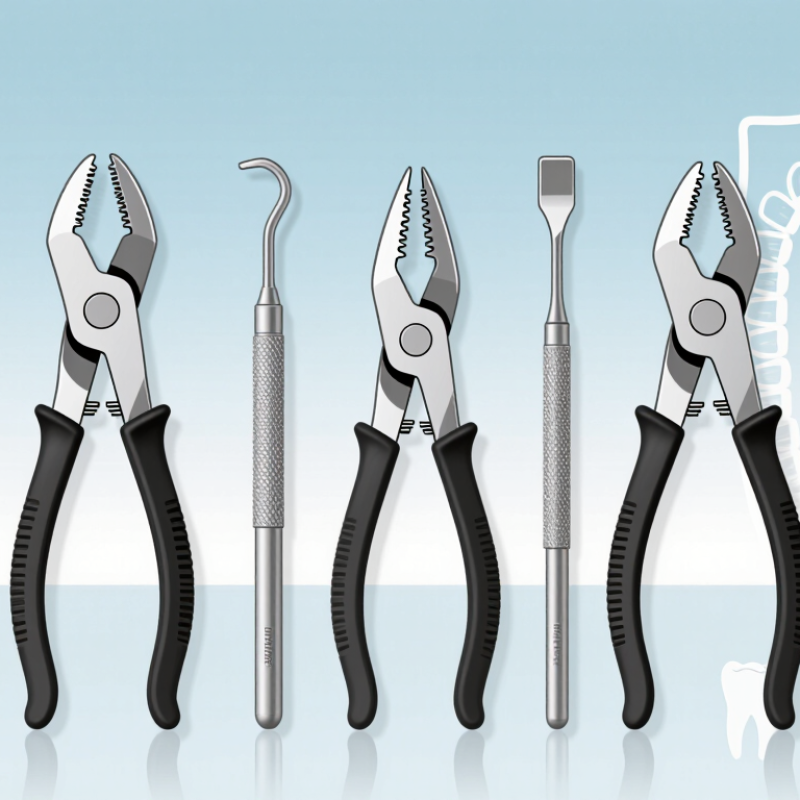
Dental extraction forceps are hand-operated surgical instruments used to remove teeth from their sockets. They help clinicians apply controlled pressure during extraction procedures. Their design supports grasping, loosening, and delivering a tooth with minimal unnecessary movement. The instrument is not a substitute for clinical judgment.
The handles provide leverage for the operator. The joint transfers hand movement toward the beaks. Beaks contact the tooth crown or root surface. Their shape, width, angle, and inner texture vary by tooth anatomy. Narrow beaks may suit limited spaces. Broader beaks can support larger surfaces. A close fit matters.
They check alignment, surface condition, and smooth opening. A loose joint can reduce control. Excessive sharpness may damage soft tissue. These details are easy to overlook. Proper cleaning, sterilization, and corrosion resistance also affect instrument reliability. Global buyers should review material specifications, dimensional consistency, and quality documentation before purchasing. Packaging must protect the joint and working edges during transport. Even experienced teams may select instruments from habit. That habit deserves review, because tooth position, root shape, and access can change the appropriate forceps choice.
Dental extraction forceps should match both tooth anatomy and the planned procedure. Straight beaks are commonly selected for maxillary incisors and canines, where roots usually follow a relatively direct path. Maxillary premolar forceps often have slimmer, angled beaks for improved access. Maxillary molar forceps use opposing beak shapes for right and left sides, while bayonet-style instruments can help reach posterior teeth or retained roots.
Mandibular teeth usually require stronger, more controlled designs. Narrow beaks suit lower incisors and roots. Mandibular molar forceps may use pointed beaks that engage the furcation during a simple extraction. For fragile crowns, root fragments, or surgical cases, root-tip forceps and elevators may provide better control than broad extraction forceps. Pediatric forceps are smaller and better suited to primary teeth. Fit matters more than appearance. An attractive instrument can still feel unstable.
Tips: Check the beak alignment before sterilization and again before use. The beaks should contact the tooth without crushing soft tissue. Choose the smallest effective forceps. Excessive pressure can fracture a crown or damage surrounding bone. Confirm right-side and left-side molar patterns carefully, especially when purchasing mixed inventory. In practice, selection is not always perfect; clinical access, root curvature, and tooth condition may change the preferred instrument. Cleaning hinges, inspecting serrations, and following validated sterilization procedures support safer, repeatable performance.
Main types of dental extraction forceps by tooth region and procedure
Reference scope: conventional clinical classifications used for anterior teeth, premolars, molars, roots, fragments, and pediatric extractions.
Dental extracting forceps are not interchangeable tools. Their design directly affects grip, access, control, and tissue protection. Global buyers should assess clinical function before comparing prices or product quantities.
Beak shape determines how the instrument engages the tooth. Narrow beaks can reach crowded posterior areas, while broader beaks distribute pressure across stronger tooth surfaces. Straight beaks support controlled anterior extraction. Angled beaks improve visibility around molars. Serrated inner surfaces may reduce slipping, but excessive sharpness can damage enamel or soft tissue.
Handle length also matters. Longer handles increase leverage, yet they may reduce tactile feedback.
Hinge quality influences smooth opening and closing. A tight hinge can cause hand fatigue. A loose hinge may reduce control. Spring-assisted designs can support repeated procedures, although some clinicians prefer a direct, traditional feel. That preference deserves testing, not assumption.
In procurement reviews, I would compare beak alignment, surface finish, locking movement, and sterilization compatibility.
A forceps that feels comfortable in a showroom may feel different after repeated cleaning cycles.
Small details matter. The operator’s hand size, extraction site, patient anatomy, and tooth condition should guide selection. No single forceps type performs perfectly in every case.
2026 Top Dental Extracting Forceps Types for Global Buyers
How Global Buyers Can Select Suitable Extraction Forceps
Global buyers should select dental extracting forceps by procedure, anatomy, and sterilization workflow. Universal forceps suit routine extractions, while molar, root, and pediatric patterns require more precise beaks. Upper molar forceps need right- or left-sided designs. Lower molar forceps usually require stronger, horizontally aligned beaks. A catalog photo is never enough.
The World Health Organization’s Global Oral Health Status Report (2022) estimates that oral diseases affect nearly 3.5 billion people worldwide. This scale creates varied clinical needs across markets. Buyers should check beak curvature, tip thickness, serration, hinge movement, and handle balance. The U.S. CDC reported periodontal disease in 47.2% of adults aged 30 years or older, based on NHANES 2009–2014 data. Fragile periodontal tissues demand controlled grip, not excessive force. Small details matter.
Material documentation should align with ISO 7153-1 principles for surgical instruments. Confirm corrosion resistance, repeated sterilization performance, and traceability records. Test several samples before placing a large order. Some instruments feel smooth but lose alignment after repeated autoclave cycles. That is a warning. Buyers should also review packaging integrity, inspection procedures, and local registration requirements. This process is slower, but cheaper than replacing unreliable instruments.
2026 Top Dental Extracting Forceps Types for Global Buyers
Dental extracting forceps require more than an attractive catalog image. Experienced buyers inspect jaw alignment, hinge movement, handle balance, and surface finish. The beaks should meet evenly without visible gaps. The hinge should open smoothly, without lateral wobble. Small defects matter.
Material selection affects durability and patient safety. Common surgical stainless steels, including 410 or 420 grades, offer useful hardness and corrosion resistance. However, grade names alone prove little. Request material certificates, hardness data, passivation details, and corrosion testing records. A matte, polished surface can reduce cleaning residue, but excessive polishing may weaken edge definition. I have seen purchasing teams overlook this trade-off.
Standards should match the destination market. Ask whether the manufacturer operates under ISO 13485 quality controls. Review applicable material and surgical-instrument standards, such as ISO 7153-1 or ASTM F899, when relevant. Regulatory documents should be traceable to the exact model and production batch. Do not accept generic certificates.
One detail is easy to miss. Confirm whether the forceps are supplied sterile or reusable. Reusable models need validated cleaning, disinfection, and sterilization instructions. Packaging should protect the hinge and tips during long-distance transport. Buyers should also check sample consistency, annual inspection plans, warranty terms, and replacement availability. A practical trial with several operators may reveal grip fatigue or uneven extraction control. Specifications can still miss real clinical handling.
| Forceps Type | Typical Clinical Application | Jaw / Beak Configuration | Common Material Options | Typical Overall Length | Important Quality Requirements | Commonly Referenced Standards and Regulations | Purchasing Considerations for Global Buyers |
|---|---|---|---|---|---|---|---|
| Upper Universal Forceps | Routine extraction of maxillary incisors, canines and premolars; suitable for general-purpose procedures. | Straight or slightly angled beaks with a relatively symmetrical profile; smooth internal gripping surfaces. | Martensitic stainless steel 410/420-series options | Approximately 150–180 mm, depending on pattern and handle design. | Accurate jaw alignment, controlled hinge movement, secure grip, rounded external edges and resistance to repeated steam sterilization. | ISO 7153-1 for materials used in surgical instruments; ISO 17664-1 for processing information; ISO 13485 for medical-device quality systems where applicable. | Confirm left/right or universal configuration, adult or pediatric size, surface finish, hinge tolerances and validated cleaning and sterilization instructions. |
| Lower Universal Forceps | Routine extraction of mandibular incisors, canines and premolars. | Beaks generally set at an angle to the handles to improve access to the lower arch; narrow tips support anterior applications. | Stainless steel Low-magnetic surgical steel options | Approximately 145–175 mm. | Stable box lock or hinge, smooth opening and closing, consistent beak contact and sufficient handle leverage without excessive flexing. | ISO 7153-1; ISO 17664-1; ISO 14971 for risk-management processes; destination-market medical-device requirements. | Check compatibility with the buyer’s sterilization cycle, corrosion resistance after alkaline or enzymatic cleaning, and packaging protection during transport. |
| Upper Molar Forceps | Extraction of maxillary first and second molars. | Often supplied as right- and left-sided patterns; beaks are shaped to engage the buccal and palatal root areas. | Hardened stainless steel Matte or satin finish | Approximately 160–190 mm. | Correct side-specific geometry, precise beak symmetry, durable tips, smooth hinge action and adequate resistance to jaw deformation. | ISO 7153-1; ISO 17664-1; ISO 13485 where the product is manufactured under a certified quality system. | Order right and left patterns separately when required; request dimensional drawings, hardness data, corrosion testing and sample approval before bulk purchase. |
| Lower Molar Forceps | Extraction of mandibular molars, including teeth with separated or bifurcated roots. | Broad beaks with a central projection or pointed profile designed to engage the buccal and lingual root bifurcation area. | Martensitic stainless steel Heat-treated steel | Approximately 155–185 mm. | Strong, accurately positioned tips; high resistance to spreading; secure hinge; no sharp external burrs or excessive jaw play. | ISO 7153-1; ISO 17664-1; ISO 14971; applicable national medical-device legislation. | Evaluate jaw thickness, tip geometry, leverage, operator comfort and the supplier’s control of heat treatment and final inspection. |
| Cowhorn Forceps | Removal of mandibular molars when the roots are clearly divided and accessible at the furcation. | Long, pointed, horn-shaped tips designed to engage the furcation; requires careful clinical selection and technique. | Hardened stainless steel Polished or satin steel | Approximately 155–185 mm. | Accurate pointed-tip alignment, strong tip retention, controlled hinge movement and resistance to tip bending or fracture. | ISO 7153-1; ISO 17664-1; ISO 14971; destination-market requirements for reusable invasive instruments. | Verify tip dimensions and alignment with production samples; specify protective packaging because pointed tips can be damaged during shipment. |
| Root-Tip and Fragment Forceps | Removal of small root fragments or retained tooth portions where limited access requires narrow working ends. | Slender, narrow and elongated beaks; some patterns have angled tips for improved visibility and access. | Fine-grain stainless steel Corrosion-resistant finish | Approximately 125–165 mm. | Fine tip alignment, adequate spring-back, minimal lateral play, smooth surfaces and sufficient strength without excessive tip thickness. | ISO 7153-1; ISO 17664-1; ISO 13485 where applicable; local requirements for reusable surgical instruments. | Request working-end photographs or drawings, tip-width measurements, fatigue-testing information and confirmation that cleaning brushes can reach narrow areas. |
| Bayonet or Offset Forceps | Access to posterior teeth or difficult-to-reach areas where an offset handle improves visibility. | Angled or bayonet-shaped shank places the handle away from the working field; jaw design varies by tooth application. | Stainless steel Textured or satin handle | Approximately 150–190 mm. | Rigid offset geometry, accurate alignment, balanced weight distribution, smooth hinge and resistance to torsional deformation. | ISO 7153-1; ISO 17664-1; ISO 14971; applicable import and medical-device controls in the destination country. | Check actual working angle, right/left orientation, handle ergonomics, instrument-tray compatibility and protection against bending during logistics. |
| Pediatric Extraction Forceps | Extraction of primary teeth and selected procedures involving smaller mouths and limited operating space. | Compact, narrower beaks and shorter or slimmer handles; patterns may be straight, angled or tooth-specific. | Stainless steel Satin low-glare finish | Approximately 120–155 mm. | Small working ends, atraumatic external contours, reliable grip, low operating force and compatibility with standard sterilization processes. | ISO 7153-1; ISO 17664-1; ISO 14971; destination-market rules for reusable dental instruments. | Specify primary-tooth patterns, handle circumference, instrument weight, color coding if used, and evidence of usability for pediatric procedures. |
| Serrated-Grip Extraction Forceps | General extraction applications where additional surface purchase is desired on the crown or root portion. | Internal beak surfaces include fine serrations or textured contact zones; external contours should remain smooth and atraumatic. | Heat-treated stainless steel Fine satin finish | Approximately 145–185 mm. | Uniform serration depth, clean machining, no sharp external burrs, secure gripping action and complete cleanability after use. | ISO 7153-1; ISO 17664-1; ISO 14971; applicable national requirements for reusable medical devices. | Assess whether serrations can be effectively brushed and inspected; request cleaning validation information and inspect for crevices that may retain debris. |
It is a hand-operated surgical instrument for removing teeth from their sockets. It helps clinicians grasp, loosen, and deliver teeth with controlled pressure. It does not replace clinical judgment.
Most designs include two handles, a joint, and working beaks. Handles provide leverage. The joint transfers hand movement to the beaks.
The beaks should contact the tooth securely without crushing soft tissue. Narrow beaks suit limited spaces. Broader beaks distribute pressure across stronger surfaces.
Straight beaks are commonly selected for upper incisors and canines. Their roots often follow a relatively direct path. Access still varies.
Upper molar forceps often use opposing shapes for right and left sides. Angled or bayonet-style beaks can improve posterior access. Side selection must be checked carefully.
They may provide better control for fragile crowns, root fragments, or surgical cases. Broad forceps are not ideal for every extraction. Fit matters more than appearance.
Beak shape, handle length, hinge quality, and inner texture affect grip and access. Longer handles increase leverage but may reduce tactile feedback. That tradeoff deserves testing.
Review material specifications, dimensional consistency, corrosion resistance, and quality documentation. Check alignment, surface finish, hinge movement, and sterilization compatibility. Packaging should protect the joint and working edges.
Inspect alignment and smooth opening before treatment. Clean the hinge and inspect serrations. Follow validated sterilization procedures. Small details matter.
No single design works perfectly in every case. Tooth position, root curvature, access, and tooth condition can change the choice. Habit can mislead.
Dental extracting forceps are specialized hand instruments designed to grasp, loosen, and remove teeth safely and efficiently. Their structure typically includes handles, a hinge, and working beaks shaped for different tooth positions and root forms. Common types are selected according to the tooth and procedure, including forceps for incisors, premolars, molars, and retained roots. Variations in beak width, angle, curvature, and surface texture help clinicians achieve controlled access, secure grip, and reduced trauma to surrounding tissues.
For global buyers, choosing suitable forceps requires considering the intended procedures, ergonomic comfort, sterilization methods, and compatibility with clinical workflows. High-quality instruments should be made from durable, corrosion-resistant materials and maintain precise alignment after repeated use. Buyers should also review manufacturing consistency, surface finish, packaging, traceability, and applicable quality and safety standards in their target markets. Careful evaluation of design, materials, supplier reliability, and purchasing requirements supports long-term performance and dependable clinical use.