
Surgical Instrument Manufacturer Dental root elevators are small instruments with a demanding job. Their tip must enter a narrow periodontal space, transmit controlled force, and remain stable in the operator’s hand. For global buyers, choosing the right model involves more than comparing prices or polished surfaces.
The World Health Organization’s Global Oral Health Status Report 2022 estimates that oral diseases affect nearly 3.5 billion people worldwide. It also reports that untreated caries in permanent teeth affects about 2 billion people. These figures indicate sustained demand for safe, durable dental instruments. However, demand alone does not identify the best elevator. That assumption needs testing.
This guide reviews seven dental root elevators for international purchasing teams, distributors, clinics, and dental laboratories. The assessment considers blade design, working-end thickness, handle balance, stainless-steel quality, surface finish, sterilization resistance, and supplier documentation. The CDC’s Summary of Infection Prevention Practices in Dental Settings emphasizes cleaning, heat sterilization, packaging, and instrument traceability. These requirements should influence every purchasing decision.
A practical detail matters. An elevator that feels secure during a dry trial may become slippery with gloves, irrigation, or blood. Handle texture deserves attention. So does the transition between shaft and blade. Weak finishing can create cleaning challenges, even when the instrument looks professional.
No single elevator suits every extraction technique. Experienced clinicians may prefer different angles, widths, and leverage profiles. Regulatory expectations also vary between markets, so buyers should verify applicable registration, material declarations, and quality-system records. ISO 13485 certification can support confidence, but it does not replace clinical evaluation. A careful comparison remains necessary. Surface appearance is not proof of performance.
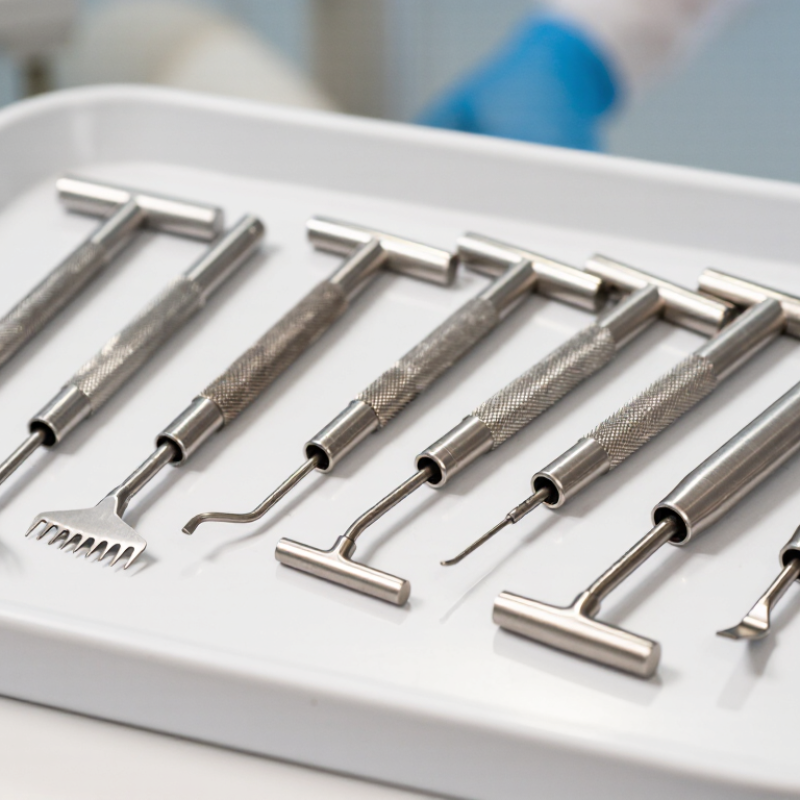
Dental root elevators are hand instruments used to loosen and remove retained roots or teeth. They work through controlled wedge, lever, and rotational forces. The thin working end enters the periodontal ligament space and gradually separates the root from surrounding bone. The handle transfers pressure, while the shaft controls direction and depth.
They are not miniature chisels. Excessive force can fracture a root, damage cortical bone, or injure nearby tissues. A straight elevator suits many routine luxation steps, while angled and triangular designs can improve access around molar roots.
Narrow apical elevators help retrieve small fragments, but their tips require careful handling. For a seven-piece set, global buyers should compare working-end geometry, shaft rigidity, grip balance, corrosion resistance, and validated cleaning instructions.
Demand for dependable extraction instruments remains connected to a substantial oral-health burden. The World Health Organization’s Global Oral Health Status Report 2022 estimates that oral diseases affect nearly 3.5 billion people worldwide. That figure does not prove every extraction requires an elevator. It does show why consistent, reusable instruments matter across clinics. ISO-aligned manufacturing controls, traceable materials, and documented quality testing strengthen purchasing confidence. Still, no elevator is universally best. Operator training, radiographic findings, root shape, bone density, and access often matter more than appearance. Even experienced clinicians can misjudge resistance, so a smaller instrument and slower force may be the safer choice.
Selecting the seven best dental root elevators depends on anatomy, access, and fracture risk, not popularity. The World Health Organization’s Global Oral Health Status Report 2022 estimates that oral diseases affect nearly 3.5 billion people worldwide. This scale makes dependable extraction instruments essential, especially where treatment resources vary.
Straight elevators suit initial luxation in accessible teeth. Small apical elevators help retrieve visible root fragments from narrow sockets. Cryer elevators provide controlled leverage around separated roots, while angular elevators improve access in posterior regions. Warwick James patterns can assist with curved or deeply positioned fragments. Root-tip picks offer delicate engagement, but they demand excellent tactile control. Periotomes and luxators focus more on periodontal ligament separation than forceful elevation, supporting conservative extraction techniques.
The best design still depends on the operator’s experience. That assumption fails. Excessive leverage may fracture bone, damage adjacent teeth, or push a fragment deeper. WHO reports that untreated caries affects about 2 billion permanent teeth, showing the enormous global need for practical dental care, but it does not endorse one elevator type. Buyers should examine stainless-steel quality, handle balance, tip geometry, sterilization compatibility, and available sizes. Clinical training matters more than a polished catalog. A small elevator can feel safer, yet poor angulation can make it hazardous. Selection should follow the extraction plan, radiographic findings, and local professional standards.
How to Evaluate the 7 Best Root Elevators for Global Buyers
The WHO Global Oral Health Status Report 2022 estimates that oral diseases affect nearly 3.5 billion people worldwide. This scale makes dependable extraction instruments essential, not decorative. When comparing seven root elevators, buyers should examine blade geometry, working-end thickness, handle balance, and surface finishing. A narrow tip may access confined areas, while a broader tip can distribute force more evenly. Neither design is universally superior. Clinical experience matters.
Check the material certificate and resistance to repeated cleaning cycles. ISO 7153-1 identifies commonly used materials for surgical instruments, but material selection alone does not prove durability. Ask for hardness data, corrosion testing, and sterilization validation. A smooth transition between blade and shank helps reduce debris retention. It also supports easier inspection. Small details matter.
Test them physically.
Grip comfort should remain stable with wet gloves. Excessive handle weight may increase fatigue during long procedures. Request traceability records, inspection procedures, and product samples before purchasing. The WHO report also identifies untreated caries as one of the most prevalent health conditions, showing why clinics need reliable instruments across varied workloads. However, laboratory claims can feel perfect while real handling reveals weakness. That is the uncomfortable part. A weighted scoring sheet, trial use, and feedback from experienced dental professionals create stronger evidence than catalog language. Global buyers should also verify documentation for their destination market, packaging integrity, and after-sales replacement support.
| No. | Root Elevator Type | Typical Working-End Design | Common Clinical Application | Typical Overall Length | Common Working-End Width | Handle and Shaft Features | Main Advantages | Important Limitations | Evaluation Score | Global-Buyer Checklist |
|---|---|---|---|---|---|---|---|---|---|---|
| 1 | Straight Root Elevator | Straight, narrow, slightly tapered blade with a flat or gently concave working surface. | Initial luxation of teeth or roots and expansion of the periodontal ligament space. | 140–185 mm | 2–5 mm | Round or octagonal handle; straight shaft for direct axial access. | Versatile, easy to control, and suitable as a basic instrument in most extraction sets. | Less effective when access is restricted or when the root fragment is positioned at an angle. | 9.0/10 | Essential starter type Check blade thickness Confirm tip symmetry |
| 2 | Curved Root Elevator | Blade curves laterally or distally to follow the contour of a socket or root surface. | Removal of retained roots where a straight instrument cannot achieve a suitable line of access. | 145–185 mm | 2.5–5.5 mm | Curved shank with a textured or polygonal handle for improved orientation. | Provides better access around adjacent teeth and into curved or offset root spaces. | Requires careful positioning; excessive lateral force may damage the alveolar bone or adjacent tooth. | 8.6/10 | Useful for angled access Inspect curve consistency Avoid overly thin tips |
| 3 | Right-Angled Root Elevator | Working end is set at approximately 90 degrees to the shaft, commonly with a small pointed or flat tip. | Accessing posterior root fragments and engaging roots when direct axial access is difficult. | 135–180 mm | 2–4.5 mm | Angled neck with a firm handle designed for controlled rotational movement. | Improves access in posterior regions and allows engagement from a lateral direction. | Limited visibility can increase the risk of slipping if the tip does not seat securely. | 8.4/10 | Check angle accuracy Assess neck strength Verify secure grip |
| 4 | Left-Angled Root Elevator | Mirror-image angled design for access from the opposite side of the socket or tooth. | Controlled elevation of root fragments in areas where a right-angled instrument does not align with the anatomy. | 135–180 mm | 2–4.5 mm | Laterally offset working end; commonly paired with a right-angled version. | Provides directional flexibility and helps reduce awkward wrist positioning. | Usually less versatile as a standalone purchase and must be matched to the operator’s working direction. | 8.1/10 | Buy as a matched pair Confirm left orientation Check tip alignment |
| 5 | Triangular Root Elevator | Triangular or pointed working end designed to engage a purchase point on a fractured root. | Retrieval of retained root fragments when a clear purchase point is available. | 140–180 mm | 2–5 mm across the working end | Rigid shaft with a narrow, penetrating tip and high-torque handle. | Can obtain a firm purchase on selected root fragments and is effective in experienced hands. | Not suitable for blind force; incorrect use may cause root displacement, bone damage, or instrument slippage. | 8.3/10 | Use only with visibility Check tip sharpness Review safety instructions |
| 6 | Apical Root Elevator | Very narrow, elongated tip intended to reach deeper apical areas and small root remnants. | Retrieval of small apical fragments after adequate visualization and socket preparation. | 150–190 mm | 1–2.5 mm | Long, slim shaft; usually supplied with a compact handle for delicate manipulation. | Offers access to narrow spaces and small fragments that wider elevators cannot engage. | Thin tips are more vulnerable to bending or fracture if used for heavy leverage or prying. | 7.9/10 | Check flexibility resistance Inspect for distortion Use low controlled force |
| 7 | Molar Root Elevator | Broader, robust working end with a shape adapted to larger posterior roots and stronger resistance. | Luxation and removal of substantial molar root segments after appropriate tooth sectioning or socket access. | 145–185 mm | 4–8 mm | Thicker shaft and larger ergonomic handle for controlled force transmission. | Strong construction and good stability for larger root fragments and posterior procedures. | Too large for narrow sockets or small anterior roots; improper force can cause bone or tooth damage. | 8.5/10 | Check working-end width Evaluate shaft rigidity Confirm posterior access |
Global buyers should compare seven practical root-elevator designs: straight, angled, triangular, narrow, wide, curved, and controlled-grip versions. Each serves different access conditions. A narrow tip may reach a deep socket, while a wider blade distributes force more evenly. The best choice is not always the sharpest one.
Material selection needs evidence, not attractive catalog language. ISO 7153-1 identifies stainless-steel materials suitable for surgical instruments, but buyers should still request alloy composition, hardness data, and corrosion testing. A matte or polished surface should resist staining and support cleaning. It can still hide tiny machining marks. Check the heel, shank, and blade transition closely. That area often receives repeated bending stress.
Design quality also includes grip texture, balanced weight, atraumatic edges, and secure packaging. WHO’s Global Oral Health Status Report 2022 estimates that nearly 3.5 billion people live with oral diseases, increasing the need for dependable clinical instruments worldwide. Ask suppliers for ISO 13485 certification, ISO 17664 reprocessing instructions, and traceable inspection records. A serious quality file should include dimensional tolerances, passivation results, sterilization validation, and batch identification. ASTM F899 may support further stainless-steel verification. Do not treat certificates as proof of perfect performance. Test samples with simulated extraction loads, repeated cleaning cycles, and visual inspection. Some specifications remain vague. That deserves scrutiny.
Comparative buyer score based on material suitability, tip design, handle control, sterilization readiness, and quality-documentation requirements.
Scores use a 1–10 purchasing checklist for reusable dental instruments. Higher values indicate stronger suitability for routine global procurement. Buyers should verify stainless-steel grade, corrosion resistance, edge geometry, cleaning instructions, packaging, traceability, and applicable quality systems such as ISO 13485, ISO 17664, and relevant stainless-steel instrument requirements before purchase.
7 Best Dental Root Elevators for Global Buyers
Purchasing, Sterilization, and Supplier Considerations Worldwide
Global buyers should assess seven practical configurations: straight, curved, angled, apical, triangular, fine luxating, and narrow-blade elevators. Each shape should match root anatomy, access depth, and extraction control. A balanced handle, clear size marking, and a polished working end matter during real procedures. Stainless steel quality is not always obvious from photographs. Ask for material certificates, hardness data, corrosion testing, and dimensional drawings before ordering. The WHO 2022 Global Oral Health Status Report estimates that oral diseases affect nearly 3.5 billion people worldwide, creating sustained demand for dependable dental instruments.
Sterilization must follow the instrument’s validated instructions for use, not a supplier’s casual recommendation. CDC guidance states that critical dental instruments require heat sterilization, while chemical indicators should be used inside each package. Biological monitoring should occur at least weekly. Elevators need complete cleaning around the handle, joint, and blade shoulder; trapped debris can remain after an attractive surface inspection. Choose suppliers with ISO 13485 quality systems, ISO 17664 reprocessing information, batch traceability, and documented inspection records. Verify packaging integrity after transport, especially where humidity and temperature fluctuate. A supplier may provide certificates. That does not prove every shipment is consistent. Request sample testing, sterilization-cycle compatibility, and replacement terms in writing. Some buyers overlook training materials, yet poor handling can bend a precise tip quickly. This is an uncomfortable purchasing gap worth reviewing.
Dental root elevators loosen retained roots and teeth. They use controlled wedge, lever, and rotational forces. They are not miniature chisels.
The thin tip enters the periodontal ligament space. Gradual pressure separates the root from surrounding bone. The handle transfers force. The shaft controls direction and depth.
Straight elevators suit accessible teeth and early loosening. Narrow apical elevators help retrieve small visible fragments. Angled designs improve access around posterior roots. Triangular patterns can engage separated roots. Periotomes and luxators focus on ligament separation.
No single design is universally best. Root shape, bone density, access, and radiographic findings affect selection. Operator experience matters more than appearance. That assumption can fail.
Excessive force may fracture a root or cortical bone. It can also injure nearby tissues. A fragment may move deeper. Slower pressure with a smaller instrument may be safer.
Compare tip geometry, shaft rigidity, grip balance, and corrosion resistance. Check working-end thickness and surface finishing. Request material certificates and durability data. Samples reveal details catalogs may hide.
Ask for validated cleaning instructions and sterilization information. Check resistance to repeated cleaning cycles. Inspect smooth blade-to-shank transitions. Trapped debris is a warning sign.
Test the instruments with wet gloves. The grip should remain stable during controlled pressure. Excessive handle weight may increase fatigue. Physical testing matters.
Request traceability records, inspection procedures, packaging details, and replacement support. Verify destination-market requirements. Laboratory claims may look perfect. Real handling can disagree.
Dental root elevators are essential instruments used to loosen and remove tooth roots during extraction procedures. By applying controlled leverage between the root and surrounding bone, they help dental professionals improve access while reducing unnecessary pressure on adjacent tissues. Different designs, including straight, angled, and specialized forms, are suited to varying root shapes, locations, and extraction challenges. This guide explains how these instruments work and highlights seven leading options for global buyers based on handling, versatility, precision, and overall value.
It also outlines the key factors for comparing Dental root elevators, including stainless-steel composition, tip strength, surface finish, ergonomic handles, balance, and resistance to corrosion. Buyers should assess manufacturing consistency, quality documentation, packaging, and compatibility with accepted sterilization methods. Reliable purchasing decisions also require checking supplier communication, product traceability, delivery capabilities, and after-sales support. By considering clinical requirements, instrument durability, hygiene procedures, and regional purchasing standards together, dental facilities can select dependable root elevators for safe and efficient use.