 Surgical Instrument Manufacturer Surgical Instrument Manufacturer
 Engineered from German-grade AISI 420 & 440 stainless steel. Autoclavable, corrosion-resistant, and ergonomically balanced for minimally invasive tooth extractions.
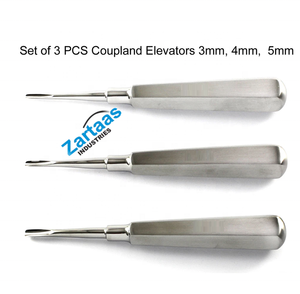
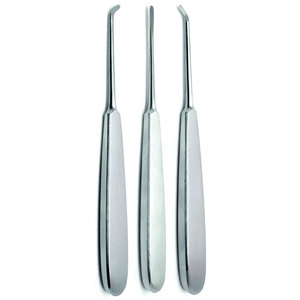
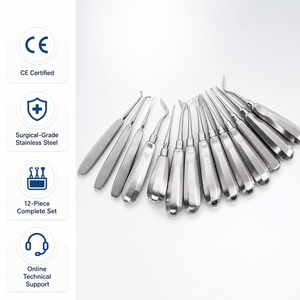
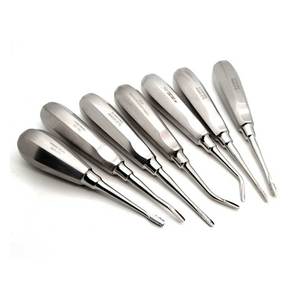
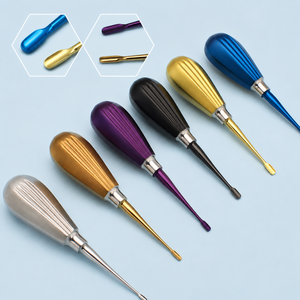
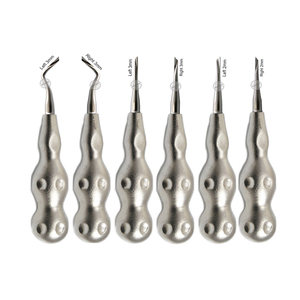
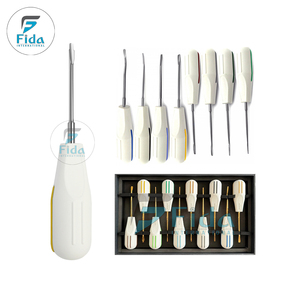
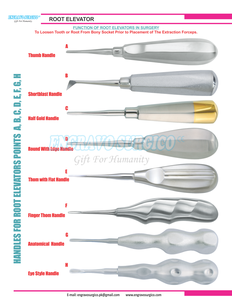
Combining state-of-the-art 5-axis CNC machining, micro-hand forging, and rigorous German-standard metallurgical testing to deliver unmatched clinical performance.
We forge all root elevators using high-grade AISI 420B, 440C, and German DIN 1.4021/1.4117 martensitic stainless steel. This guarantees optimal Rockwell Hardness (52-56 HRC), preventing tip bending or fracturing under high torsional force.
Our quality management system is fully certified to ISO 13485:2016 and ISO 9001:2015. Reusable instruments are CE marked as Class I medical devices under EU MDR 2017/745, registered in EUDAMED, and backed by US FDA Establishment Registration (3019842214).
Whether producing classic Bein, Coupland, Cryer, or micro-serrated PDL luxating tips, our automated CNC grinding processes maintain tolerances within ±0.02mm, ensuring precise tactile feel and effortless periodontal ligament severance.
Empowering global medical brands with custom fiber-laser branding, unique catalog numbering, color-coded anodized handle rings, custom packaging (blister, pouch, wooden box), and scalable production starting from just 300 units per pattern.
Every single elevator undergoes electropolishing and chemical passivation per ASTM F1083 / DIN EN ISO 16061 standards. This creates a dense chromium-oxide layer capable of enduring hundreds of 134°C autoclave steam sterilization cycles without pitting or discoloration.
Strategically positioned export channels ensuring stock pattern orders dispatch in 7–10 working days, and custom OEM bulk orders ship within 10–20 working days via DHL, FedEx, air freight, or sea containers with complete COO, CE declarations, and commercial invoices.
Dental root elevators operate on three fundamental physical principles: Lever Mechanics, Wedge Physics, and Wheel & Axle Torque. Understanding tip geometry and force vectors is critical for proper clinical selection and inventory standardization.
| Elevator Type | Mechanical Principle | Blade & Tip Geometry | Primary Clinical Application | Material & Hardness |
|---|---|---|---|---|
| Bein Elevators | Wedge & First-Class Lever | Straight, concave inner surface, rounded tip (2mm–4.5mm) | Initial dislocation of multi-rooted teeth & apical root engagement | AISI 420 / 54 HRC |
| Coupland Elevators | Wedge Force | Gouge-shaped straight blade with sharp parallel side edges | Expansion of alveolar socket & severing stubborn fibrous attachment | AISI 420B / 55 HRC |
| Cryer Elevators (Pair) | Wheel & Axle Rotation | Triangular sharp point, right-angled offset blade design | Removal of fractured posterior roots & interradicular bone clearance | AISI 440C / 56 HRC |
| PDL Luxating Hybrids | Precision Cutting Knife | Ultra-thin, flexible tapered tip (Straight, Curved, Winged) | Atraumatic cutting of periodontal ligament prior to dental implant placement | TiN Coated Stainless Steel |
| Apexo / Root Tip Pick | Micro-Lever & Wedge | Fine, narrow needle tip with angled shank offset | Retrieval of fractured root tips from deep apical thirds | AISI 420 / 53 HRC |
As oral surgery shifts toward implantology-driven socket preservation and minimally invasive exodontia, manufacturing technology and purchasing criteria are rapidly evolving.
Modern oral surgeons and implantologists are moving away from heavy socket-expanding elevators. Demand is surging for thin-bladed Luxating Periotomes and Winged Elevators that cut the periodontal ligament cleanly without fracturing the outer buccal bone plate. This preserves bone volume for immediate dental implant placement.
Black PVD and Gold Titanium Nitride (TiN) physical vapor deposition coatings are becoming standard in high-end surgical instruments. These nano-thin ceramic coatings increase surface hardness up to 2500 HV, reduce friction during deep tissue penetration, and completely eliminate light glare under operating microscopes.
To reduce hand fatigue during long surgical procedures, conventional solid heavy handles are being replaced by hollow-core, large-diameter hexagonal or anatomically contoured handles. They offer superior tactile sensitivity, optimized center of gravity, and improved balance.
Under the EU MDR and US FDA regulations, healthcare buyers require full backward supply-chain traceability. Leading manufacturers now apply high-resolution fiber laser Unique Device Identification (UDI) barcodes, matrix codes, and batch identifiers directly onto every instrument handle.
An in-depth technical analysis for hospital procurement managers, medical device importers, and dental brand owners on evaluating root elevator durability, tip sharpness, and resistance to stress-corrosion cracking.
Dental root elevators are specialized surgical instruments designed to luxate (loosen) teeth from their bony sockets prior to forcep application or to extract retained root fragments. The clinical efficacy of a root elevator relies entirely on force transmission without elastic deformation. When a surgeon applies rotational torque or axial leverage, the elevator blade experiences severe bending and shear stresses focused precisely at the shank-to-blade transition point.
Substandard elevators forged from cheap 300-series austenitic steel or poorly heat-treated martensitic steel frequently suffer from permanent deformation (bending) or catastrophic brittle fracture during elevation. Our manufacturing facilities utilize computer-controlled vacuum heat treatment furnaces to achieve a refined grain structure in AISI 420B stainless steel. This yields a Rockwell hardness of 54–56 HRC—providing the exact elastic modulus necessary to withstand high torsional torque without sacrificing ductility.
Understanding the geometrical nuance of each instrument pattern ensures accurate procurement for hospital inventory and specialty surgical kits:
Corrosion failure in reusable surgical instruments is almost always caused by improper surface finishing or chemical contamination during production. Following precision machining, our root elevators pass through multi-stage ultrasonic cleaning to remove all residual polishing compounds and metallic micro-particles.
Subsequent immersion in a temperature-controlled citric or nitric acid bath (per ASTM F1083 / ISO 16061) strips free iron molecules from the surface layer, forming a passive, self-healing Chromium Oxide (Cr₂O₃) barrier layer. This passivation process makes our instruments totally immune to pitting corrosion, rust formation, and stress-corrosion cracking over thousands of 134°C autoclave cycles.
Clear, direct answers regarding material grades, quality control testing, international certifications, and OEM manufacturing services.
We primarily utilize high-grade German and Japanese AISI 420 (1.4021) and AISI 440C martensitic stainless steel for cutting and elevating tips, offering high tensile strength and superior hardness (52-56 HRC). For handles, hollow bodies, and sterilization trays, we utilize AISI 304 and 316 austenitic stainless steel for maximum corrosion resistance.
Our standard MOQ for custom laser-branded or OEM private label root elevators starts at 300 units per pattern size. We also accommodate custom kit assembly, custom ring color-coding, private catalog numbering, and tailor-made retail blister or leather pouch packaging.
Yes. Our manufacturing facilities operate under strict ISO 13485:2016 and ISO 9001:2015 quality management systems. All reusable surgical and dental devices carry CE Mark compliance under EU MDR 2017/745 (Class I medical devices), are listed in EUDAMED, and comply with US FDA establishment registration requirements.
Every production batch undergoes five strict quality checkpoints: 1) Spectrometer material chemical composition check, 2) Rockwell Hardness testing, 3) 100% tip alignment and dimensional inspection under magnification, 4) Boil & Copper Sulfate Passivation corrosion test (per ISO 7151 standards), and 5) Autoclave steam cycle testing.
In-stock catalog items ship within 7–10 working days. Custom OEM orders, tender bulk manufacturing, or tailored sets are completed and dispatched within 10–20 working days. We ship internationally via courier (DHL, FedEx, UPS), air cargo, or ocean freight with complete documentation including Certificate of Origin (COO), CE Declaration, and packing lists.
Yes. We strongly encourage hospital procurement managers and dental distributors to request pre-production evaluation samples. Samples can be supplied for surgeon tactile testing, tip sharpness checks, and CSSD sterilization validation before placing full-scale production orders.
Looking for direct factory pricing, certified surgical quality, and reliable OEM production? Contact our international export desk today for free samples, technical catalog downloads, and custom quotation requests.
Contact Us