Standardizing Septoplasty Instrumentation for Global Procurement Directors
In high-volume ear, nose, and throat (ENT) operating theatres and plastic surgery centers, the failure rate of septoplasty instrumentation is heavily tied to metallurgy stress fatigue and mucosal tissue laceration caused by poorly calibrated blade edges. This guide addresses critical intent data, structural engineering parameters, and global regulatory compliance required when acquiring Septum Straightening Forceps.
Key Takeaways for Surgical Procurement Committees:
- Material Rigidity vs. Flexural Fatigue: Septum straightening requires high parallel force without permanent jaw alignment deviation. Fizza Surgical uses German AISI 420 martensitic stainless steel heat-treated to Rockwell C 48–52 hardness.
- Mucosal Preservation: Precision-beveled blade edges and calibrated spring-back action prevent mucoperichondrial tear during closed reduction of nasal fractures.
- Compliance & Traceability: Full European Medical Device Regulation (EU MDR 2017/745) Class I compliance, unique device identification (UDI-DI/UDI-PI), and raw material melt certs available per batch.
1. Biomechanical Functionality & Clinical Application of Septum Straightening Forceps
Septum Straightening Forceps are specialized ENT and plastic surgery tools engineered for the mechanical repositioning of devitalized, dislocated, or fractured cartilaginous and bony nasal septa. During septoplasty, septorhinoplasty, or acute nasal fracture closed reduction, surgeons must exert significant lateral and parallel clamping force to realign the vomer, perpendicular plate of the ethmoid bone, and quadrangular cartilage into the midline median plane.
Unlike standard tissue forceps or grasping clamps, dedicated Septum Straightening Forceps (such as the Asch and Walsh patterns) possess robust, parallel-acting blades designed to straddle the septum bilaterally through both nasal cavities. The primary engineering challenge lies in delivering sufficient force to fracture bony spurs or compress dislocated cartilage without exerting shear stress that could compromise the overlying mucoperichondrial flaps.
Global procurement teams must evaluate four critical design elements when selecting septum straightening instruments for hospital inventory replenishment or private-label distribution:
- Blade Curvature & Angulation: Angled shanks (typically 30° to 45°) prevent the surgeon's hand from obstructing the direct line of visual sight or endoscopic camera access into the nasal vault.
- Parallel Jaw Action: Ensures uniform compressive force across the entire 40mm–60mm contact surface of the septal wall rather than pinching localized tissue at the blade tips.
- Protective Blade Buffering: Options for smooth, micro-serrated, or vulcanized silicone/rubber blade coatings that safeguard delicate nasal mucosa during traumatic manipulation.
- Fulcrum Leverage Ratio: Ergonomically engineered pivot-to-handle ratios that maximize mechanical advantage while minimizing surgeon manual strain during difficult osteotomy alignment.
2. Definitive Septum Straightening Forceps Product Portfolio
Fizza Surgical International manufactures a comprehensive range of surgical-grade septum straightening forceps forged to exact DIN and ASTM dimensional tolerances.
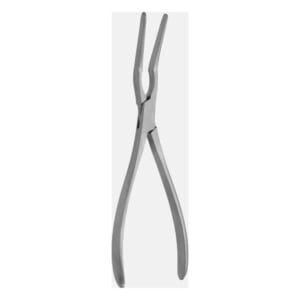
ASCH Septum Straightening Forceps
Length: 230 mm (9.0 inches)
Shank: Angled 45°
Steel Grade: AISI 420 Martensitic Stainless Steel
Engineered for severe nasal trauma reduction and thick cartilage manipulation. The flat, broad, parallel-closing blades apply broad surface force to correct deviated vomer and ethmoid structures.
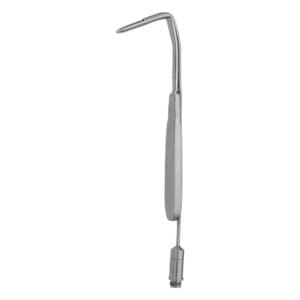
WALSH Septum Straightening Forceps
Length: 225 mm (8.75 inches)
Options: Straight or Angled Blades
Features: Rubber-guarded or fine polished surfaces
Specifically designed for delicate septal alignment where mucosal tearing risk is high. The narrower blade architecture allows access into restricted nasal passages.
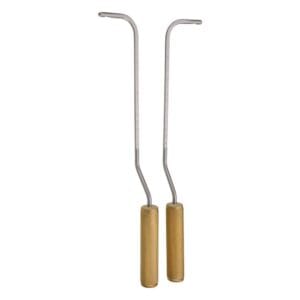
COTTLE Septum Forceps & Crushers
Length: 200 mm–210 mm
Mechanism: Integrated spring thumb mechanism / box-joint
Combines septum elevation, straightening, and cartilage flattening capabilities into a refined hand tool optimized for aesthetic rhinoplasty and septal graft preparation.
Technical Specification Comparison Table
Use the matrix below to match pattern specifications against institutional tender requirements:
| Pattern Name | Catalogue Code | Overall Length | Blade Profile | Working Tip Width | Primary Surgical Indication |
|---|---|---|---|---|---|
| Asch Septum Forceps | FS-ENT-401 | 230 mm / 9.0" | Angled 45°, Parallel Flat | 6.5 mm | Severe Nasal Fracture Reduction & Vomer Realignment |
| Walsh Septum Forceps (Straight) | FS-ENT-402S | 225 mm / 8.75" | Straight, Beveled Edge | 5.0 mm | Anterior & Mid-Septal Cartilage Alignment |
| Walsh Septum Forceps (Curved) | FS-ENT-402C | 225 mm / 8.75" | Curved Lateral, Rubber Guard | 5.0 mm | Trauma Correction with Mucosal Preservation |
| Rubin Septum Crushing Forceps | FS-ENT-405 | 210 mm / 8.25" | Heavy Duty Box-Jaw | 9.0 mm | Cartilage Crush Flattening for Autologous Grafting |
| Cottle Septum Forceps | FS-ENT-408 | 200 mm / 8.0" | Fine Angled Blades | 4.2 mm | Pediatric Septoplasty & Micro-Rhinoplasty |
3. Metallurgy, Engineering Standards, & Autoclave Lifecycle Physics
Surgical instruments utilized in nasal trauma procedures encounter significant bending moments. If an instrument is forged from inferior 300-series austenitic steel or poorly heat-treated martensitic steel, the shanks will deform permanently during osteotomy reduction. Conversely, excessive carbon content without proper tempering causes catastrophic blade fracture under load.
At Fizza Surgical International, our 40+ years of forging expertise in Sialkot ensures rigorous adherence to international metallurgical benchmarks:
3.1 Steel Selection & Chemical Composition (ISO 7153-1 / ASTM F899)
We utilize certified German AISI 420 martensitic stainless steel for all load-bearing Septum Straightening Forceps. The specific alloy chemistry provides an optimized balance between ductility and hardness:
- Carbon (C: 0.15% - 0.36%): Imparts high tensile strength and enables precision heat treatment response.
- Chromium (Cr: 12.0% - 14.0%): Forms a dense, self-healing passive Chromium Oxide ($Cr_2O_3$) surface coating that wards off oxidation, pitting, and intergranular corrosion.
- Manganese & Silicon (Mn/Si < 1.0%): Enhances structural homogeneity during hot drop-forging operations.
3.2 Heat Treatment Protocols & Hardness Testing
Each batch of forged forceps shanks undergoes computer-controlled vacuum heat treatment followed by multi-stage tempering to achieve a uniform hardness profile of Rockwell C 48 to 52 (HRC). This precise window prevents jaw splaying under parallel pressure while maintaining the spring-back flexibility needed to absorb hand force without mechanical failure.
3.3 Passivation & Surface Finishing
Following final hand-grinding and box-joint fitting, instruments are subjected to ultrasonic cleaning and chemical passivation per ASTM A967 / ISO 16061. Citric and nitric acid passivation baths remove surface tramp iron introduced during machining, guaranteeing that Fizza Septum Straightening Forceps endure over 2,000 steam sterilization cycles ($134^\circ\text{C}$ at $2.1\text{ bar}$) without discoloration, staining, or stress-corrosion cracking.
4. Future Procurement Trends in ENT & Rhinoplasty Instrumentation (2025–2030)
Global procurement managers and hospital buyers must align their purchasing strategies with emerging technological and regulatory shifts in the medical device landscape.
1. Non-Reflective Satin & PVD Finish Coatings
Modern operating rooms heavily utilize high-definition endoscopic cameras and high-intensity LED surgical headlights. Traditional mirror-polished forceps cause severe specular glare. Procurement demand is shifting rapidly toward glare-reducing satin finishes and biocompatible Titanium Nitride (TiN) Physical Vapor Deposition (PVD) coatings that increase surface hardness and visual clarity.
2. Regulatory Stringency & UDI Traceability
The implementation of EU MDR 2017/745 and FDA Unique Device Identification mandates requires every reusable instrument to carry GS1-compliant DataMatrix laser engraving. Procurement officers must partner with manufacturers capable of direct 2D DataMatrix etching for seamless Central Sterile Services Department (CSSD) asset tracking.
3. OEM Private Label Agility & Direct Sialkot Supply
Distributors are moving away from traditional European trading middlemen to reduce unit procurement costs by 30%–45%. Partnering directly with ISO 13485-certified Sialkot factories that offer private-label branding, customized blade curves, and low MOQs (300 units) provides a major competitive margin advantage.
 Sialkot, Pakistan
 5. Four Decades of Surgical Manufacturing Excellence in Sialkot
Since 1980, Fizza Surgical International has operated as a fully integrated manufacturer of surgical, ENT, dental, and orthopedic instruments. Unlike brokers or import-export agents, our end-to-end production facility in Sialkot handles every step of production under strict international quality controls.
Our commitment to E-E-A-T (Experience, Expertise, Authoritativeness, and Trustworthiness) is evidenced by our global client base across 50+ countries and our robust compliance infrastructure:
- ✓ISO 13485:2016 & ISO 9001:2015: Audited Quality Management System guaranteeing complete lot traceability.
- ✓EU MDR CE Mark Class I: Fully compliant technical documentation, EUDAMED listing, and Declaration of Conformity.
- ✓US FDA Registered: Facility Registration #3019842214 supporting seamless customs clearance into North America.
- ✓In-House Die Forging & Fitting: CNC machining, skilled master craftsman fitting, electropolishing, and laser marking.
- ✓100% Quality Inspection: Every Septum Straightening Forceps undergoes jaw alignment, ratchet locking, and boil testing prior to dispatch.
6. Frequently Asked Questions by Global Surgical Procurement Officers
Technical, regulatory, and commercial answers compiled by our senior medical device engineering team.
The primary difference lies in blade geometry, rigidity, and intended clinical trauma severity. Asch Septum Forceps feature heavier, 45°-angled, broad parallel blades engineered to deliver high compressive force required to reduce acute severe nasal bone fractures and reposition thick posterior septal cartilage. Walsh Septum Forceps feature longer, thinner, and slightly resilient blades (available straight or curved) optimized for delicate anterior septal realignment with minimal risk of lacerating the mucoperichondrial lining.
Jaw misalignment occurs when lower-grade steel deforms under heavy force. We eliminate this issue by forging our forceps shanks from high-tensile AISI 420 martensitic steel, followed by vacuum hardening to HRC 48-52. Furthermore, our master instrument makers hand-fit each box joint to eliminate lateral wobble and perform load testing exceeding maximum clinical requirements before passivation.
We offer three standard finishes: Satin (Matte) Finish (most popular for non-reflective surgical light performance), Mirror Polish (traditional high-gloss aesthetic), and Super-Cut / Gold-Plated Handles for tungsten-carbide inserted patterns. Custom PVD black or titanium coatings are also available upon request for custom product lines.
Every shipment from Fizza Surgical International includes a comprehensive regulatory document pack: Certificate of Analysis (Raw Material Mill Test Certs), ISO 13485:2016 Quality Certificate, EU MDR Class I Declaration of Conformity, Certificate of Origin (Chamber of Commerce validated), Commercial Invoice, Packing List, and Instructions for Use (IFU / Reprocessing Guidelines according to ISO 17664).
Yes. Our in-house tool and die department can reverse-engineer or manufacture custom ENT forceps from physical samples, CAD drawings, or technical sketches. We support custom blade lengths, specialized jaw curvature radii, unique handle ring ergonomical adjustments, and laser marking of custom catalog numbers.
Standard inventory patterns ship within 7–10 business days. Custom OEM orders and bulk tender runs typically require 10–20 working days for forging, machining, heat treatment, polishing, laser marking, and final QC inspection. We ship globally via DHL, FedEx, air cargo, or sea freight with complete export documentation.
Partner with Sialkot's Premier Surgical Forceps Manufacturer
Whether you are expanding your ENT product portfolio, tendering for hospital supply contracts, or seeking reliable OEM private labeling, Fizza Surgical International delivers uncompromised quality, ISO 13485 certification, and factory-direct pricing.